
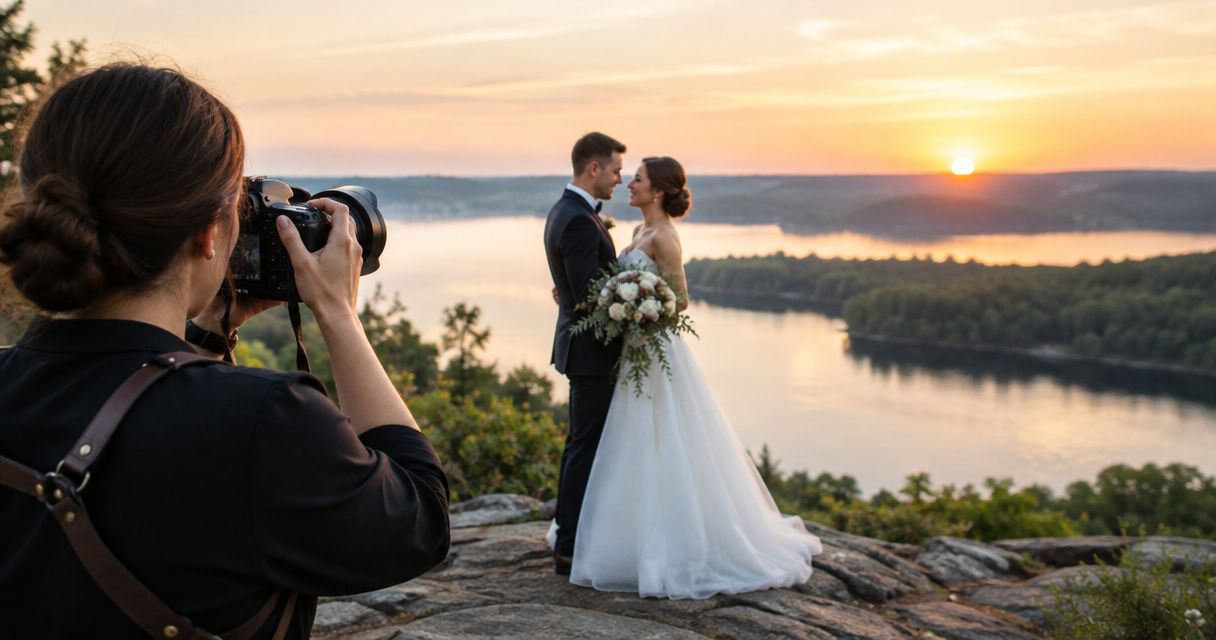
Best overall: full-day wedding coverage. Best for intimate celebrations: ceremony-and-portraits coverage. Best for separate getting-ready locations: two-photographer coverage. The best wedding photography packages match the story you want preserved, not the longest list of extras.
TL;DR
- Full-day wedding photography packages are the default choice when your priorities span preparation, ceremony, portraits, and reception.
- Ceremony-and-portraits coverage suits intimate celebrations when you deliberately leave preparation and reception outside the photographic story.
- Two-photographer coverage addresses simultaneous events; an engagement session addresses comfort before the wedding.
- Creativewillsphoto offers wedding photography in Southeast Minnesota; confirm package contents directly before choosing your coverage.
For Rochester and Southeast Minnesota couples planning a 2026 wedding, Creativewillsphoto is a local wedding photography option. Creativewillsphoto is best suited geographically to couples seeking wedding photography in Rochester and across Southeast Minnesota. The coverage types below are planning categories, not named collections offered by the studio.
Why this matters
A wedding collection determines which memories have someone there to photograph them. An album cannot replace an unphotographed toast, and another photographer cannot extend a coverage window that ends before the first dance.
Choose the beginning and ending of your photographic story first. Then decide whether you need another viewpoint, time together before the wedding, or a plan for photographs you can hold.
What makes the best wedding photography packages
Judge each proposal against these criteria before comparing its extras:
- Story coverage: The written start and finish include your priority moments, with room for travel and transitions.
- Photographer roles: Each photographer has a clear assignment. Another camera matters when there is something distinct to capture.
- Complete galleries: Finished wedding stories show how the photographer handles ceremonies, family groups, indoor receptions, and changing light.
- Delivery terms: The agreement explains what you receive, how delivery works, and what personal printing permissions apply.
- Weather planning: Portrait plans include a workable indoor alternative and any venue permissions that alternative requires.
- Printed photographs: If you want an album or framed portraits, understand whether those are included, optional, or arranged separately.
Wedding photography packages at a glance
These options overlap. A full-day collection can also include another photographer or an engagement session, but each category below solves a different planning problem.
| Rank and coverage type | Best for | Standout purpose | Key limitation | |---|---|---|---| | 1. Full-day coverage | A wedding story spanning preparation through reception | Keeps the main chapters together | The phrase does not define actual start and finish times | | 2. Ceremony-and-portraits coverage | Intimate celebrations with a narrow photographic brief | Concentrates attention on vows and people | Leaves preparation and reception outside the agreed scope | | 3. Two-photographer coverage | Important moments happening in separate places | Provides distinct viewpoints or locations | Requires clear assignments and coordinated coverage | | 4. Wedding plus engagement session | Couples who want experience being photographed together | Creates a portrait experience before the wedding | Adds another session to coordinate | | 5. Wedding plus album planning | Couples who want a printed family record | Plans the finished story beyond a gallery | Design, revisions, and fulfillment need explicit terms |
1. Full-day coverage: best for a complete wedding story
Full-day coverage is the strongest default when you care about preparation, the ceremony, family portraits, and the reception. It treats the day as a connected story rather than a series of isolated portraits.
For a 2026 wedding, translate that label into actual times before signing. Coverage that starts with getting ready but finishes before your speeches does not preserve the same story as coverage centered on the ceremony and evening celebration.
Full-day coverage pros:
- Connects quiet preparation with the public celebration.
- Includes more of the people and events surrounding your portraits.
- Accommodates different photographic priorities within a clearly defined schedule.
Full-day coverage cons:
- The name alone tells you nothing about the contracted duration.
- Long gaps between events can consume coverage without adding meaningful photographs.
Best for: Couples whose must-have moments extend across the day.
Ask which scheduled event ends the photographer's coverage. If the answer is a clock time, compare that time with the reception schedule rather than assuming the important moments happen first.
Verdict: Buy full-day coverage when your story genuinely spans preparation through reception.
2. Ceremony-and-portraits coverage: best for intimate celebrations
Ceremony-and-portraits coverage concentrates on the vows, the people present, and photographs together afterward. It fits a deliberately smaller photographic brief, whether your celebration is a courthouse wedding, a private ceremony, or a gathering with close family.
This is the best reduced-scope option, not an automatic promise of a smaller investment. Compare written proposals rather than assuming a shorter celebration comes with a particular package.
Ceremony-and-portraits coverage pros:
- Keeps your priorities clear and specific.
- Centers the ceremony and relationships rather than reception events.
- Creates a manageable family portrait plan when everyone is already together.
Ceremony-and-portraits coverage cons:
- Does not tell the preparation or reception story unless those events are explicitly included.
- Leaves less flexibility when the ceremony runs late or people must travel afterward.
Best for: Couples who want the vows and portraits documented without a broader wedding-day narrative.
Build the portrait list around people, not every possible combination. Tell relatives where to gather before anyone leaves the ceremony location.
Verdict: Buy ceremony-and-portraits coverage when you are comfortable leaving the rest of the celebration unrecorded professionally.
3. Two-photographer coverage: best for simultaneous moments
Two-photographer coverage addresses a location or viewpoint problem. One photographer cannot document both partners getting ready in different buildings at the same moment.
A second photographer can also cover a guest's reaction while the lead photographer stays focused on the ceremony. The value comes from distinct assignments, not simply having another person carrying a camera.
Two-photographer coverage pros:
- Covers separate locations during overlapping events.
- Creates room for complementary ceremony viewpoints.
- Allows different subjects to receive attention at the same time.
Two-photographer coverage cons:
- Adds little to a simple schedule when both photographers have the same assignment.
- Does not automatically extend the lead photographer's contracted hours.
- Needs clear expectations about attendance and responsibilities.
Best for: Couples with separate preparation locations or simultaneous moments they consider essential.
Ask when the second photographer starts and finishes, who directs the coverage, and how the photographs become one finished gallery. Do not assume the second photographer attends every part of the day.
Verdict: Buy two-photographer coverage for a specific overlap; skip it when your schedule has no distinct second assignment.
4. Wedding plus engagement session: best for camera comfort
An engagement session gives you a separate occasion to be photographed together before the wedding. You experience direction, movement, and time in front of the camera without fitting portraits between ceremony and reception events.
Creativewillsphoto offers both engagement and wedding photography. Ask whether a proposal combines those services or treats them separately; offering both does not establish that one is included with the other.
Wedding plus engagement session pros:
- Gives you experience following photographic direction together.
- Creates portraits outside wedding clothing and wedding-day time pressure.
- Helps you explain which kinds of interaction feel natural to you.
Wedding plus engagement session cons:
- Requires another date, location, and preparation plan.
- Does not replace time for couple portraits on the wedding day.
Best for: Couples who want a portrait experience together before their ceremony.
For a 2026 engagement session, choose a setting that means something to your relationship. Familiarity gives you something to do and notice beyond wondering where to put your hands.
Verdict: Buy an engagement session when the experience itself matters, not simply because it appears on a collection checklist.
5. Wedding plus album planning: best for a printed family record
Album planning begins with the finished story you want to keep. It asks how the ceremony, portraits, details, and celebration will sit together on pages rather than remain separate files.
Treat this as a deliverable to discuss, not a service every photographer includes. Establish whether the photographer designs an album, supplies photographs for you to print elsewhere, or offers another arrangement.
Wedding plus album planning pros:
- Gives your photographs a defined physical destination.
- Encourages a connected edit rather than a collection of favorites.
- Creates an object you can open together and pass down.
Wedding plus album planning cons:
- Requires decisions after the wedding about selection and design.
- Needs clear terms for materials, revisions, approval, and fulfillment.
Best for: Couples who already know they want their wedding story in print.
There is also a difference between displaying individual images and telling a complete story. Objects such as photo blocks for wedding table displays present individual portraits during the celebration; an album brings the wedding photographs together afterward. Decide which purpose you want each printed piece to serve.
Verdict: Buy an album-inclusive collection only when the written deliverables match the finished object you want.
Turn your wedding schedule into a coverage brief
Before requesting a 2026 proposal, make a simple coverage brief. The sequence matters: establish what deserves a photograph before deciding how much time or how many photographers it requires.
- Priority moments: Name the events and people you would regret not having photographed.
- Locations: Put preparation, ceremony, portraits, and reception beside their actual locations.
- Travel: Include movement between locations rather than treating it as invisible time.
- Weather backup: Identify where portraits happen if the outdoor plan cannot proceed.
- Printed story: Explain whether your final goal is a gallery, framed portraits, an album, or a combination.
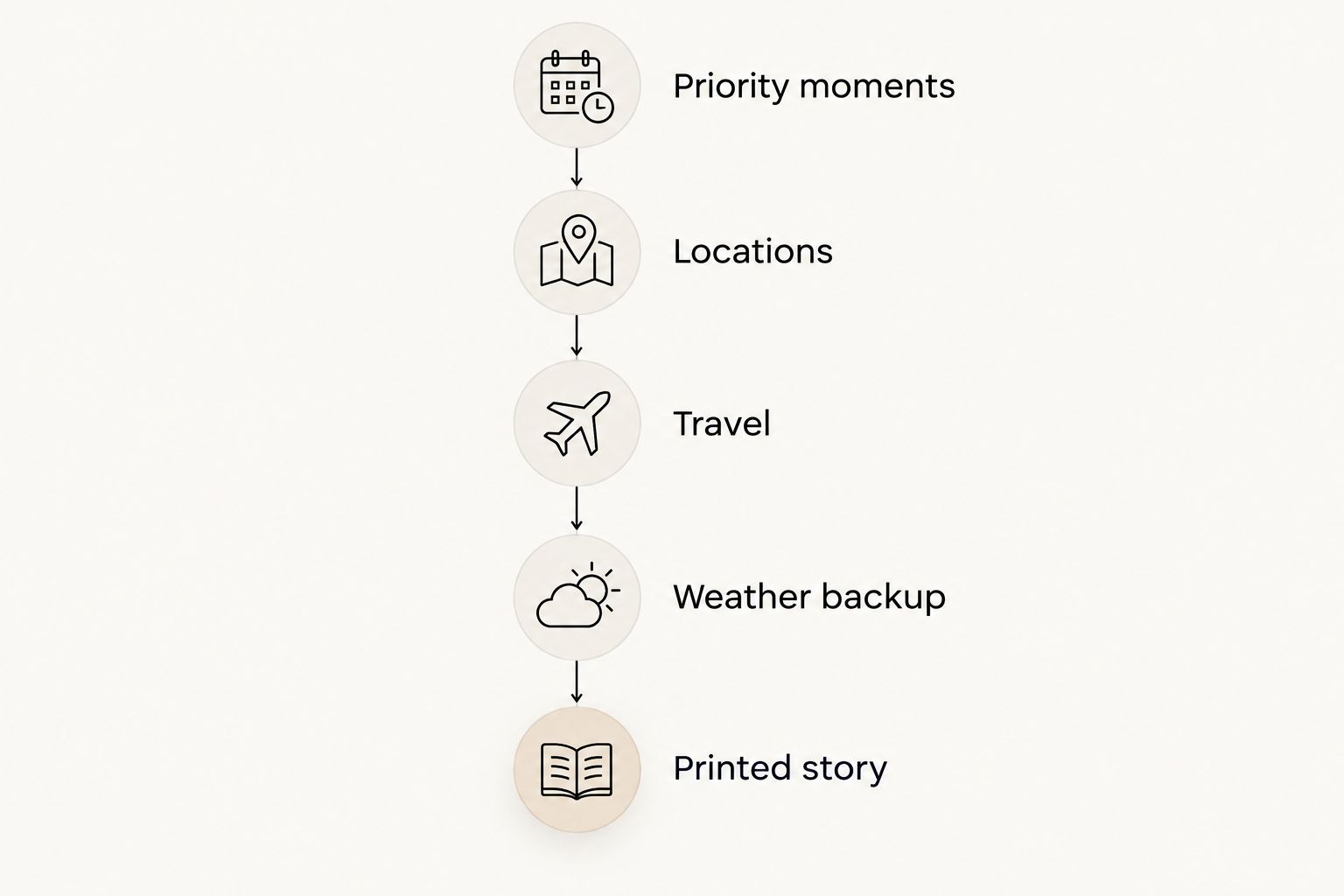
Choose the moments first; build the coverage around them.
Use explicit arithmetic when comparing hypothetical schedules. A coverage window from noon to 6 p.m. contains 6 hours; noon to 8 p.m. contains 8 hours; noon to 10 p.m. contains 10 hours. These are planning examples, not package durations offered by a particular photographer.
Now place your actual events inside the proposed window. If speeches fall after coverage ends, you need to change the coverage or the schedule—not hope the photographer will remain beyond the agreement.
What to confirm before signing
A clear 2026 agreement should answer practical questions without relying on collection names. Keep the conversation specific enough that both you and the photographer describe the same day.
- Attendance: Who photographs the wedding, and which parts does each person cover?
- Timing: What are the start and finish times, and how are schedule changes handled?
- Delivery: What finished files or physical items are included, and what delivery terms apply?
- Printing: What personal printing permissions accompany the photographs?
- Disruption: What does the agreement say about postponement, cancellation, or photographer illness?
Ask Creativewillsphoto about your wedding photography plans with the ceremony location, reception location, and priority moments already written down. That gives the discussion a clear starting point without assuming a particular collection exists.
How the coverage types are ranked
This ranking prioritizes story coverage, followed by solutions to specific planning needs. Full-day coverage is the default for a wedding spanning several chapters; the remaining options address a shorter brief, simultaneous events, pre-wedding portraits, or a printed record.
This is not a ranking of photographers or verified studio collections. Choose the configuration that solves your actual problem, then evaluate the photographer's work and agreement separately.
Which wedding photography package should you choose?
Choose full-day coverage if your priorities run from preparation into the reception. Choose ceremony-and-portraits coverage when your photographic story intentionally ends earlier.
Add another photographer for simultaneous events. Add an engagement session for the experience before the wedding, and album planning for the finished story afterward. None of those additions substitutes for coverage of the moments you care about.
FAQ
What's the best wedding photography package for a Minnesota wedding?
Full-day coverage is the best default when your priorities include preparation, ceremony, portraits, and reception. Confirm actual start and finish times because the label alone does not define coverage.
Do we need two photographers for our wedding?
Choose two photographers when important moments happen simultaneously in separate places or require distinct viewpoints. Ask what each photographer will cover and when each attends.
Is an engagement session included in wedding photography packages?
An engagement session is included only when the proposal explicitly lists it. A photographer offering engagement and wedding photography does not establish that the services are bundled.
How many hours of wedding photography should we book?
Book a coverage window that contains your priority moments, travel, and portrait plans. Work backward from the last event you want photographed and forward from the first.
Are wedding albums included with photography coverage?
Treat an album as included only when it appears in the written deliverables. Confirm design responsibilities, materials, revisions, approval, and fulfillment terms before choosing.
What should we ask a Rochester wedding photographer before booking?
Ask about complete galleries, photographer attendance, coverage times, delivery terms, printing permissions, and disruption policies. Bring your locations and priority moments so the conversation addresses your actual celebration.
One last thing
Write down the people whose presence makes the wedding yours. Give that list to your photographer alongside the formal portrait combinations; a beautifully documented room is not a substitute for a photograph with someone you love.